
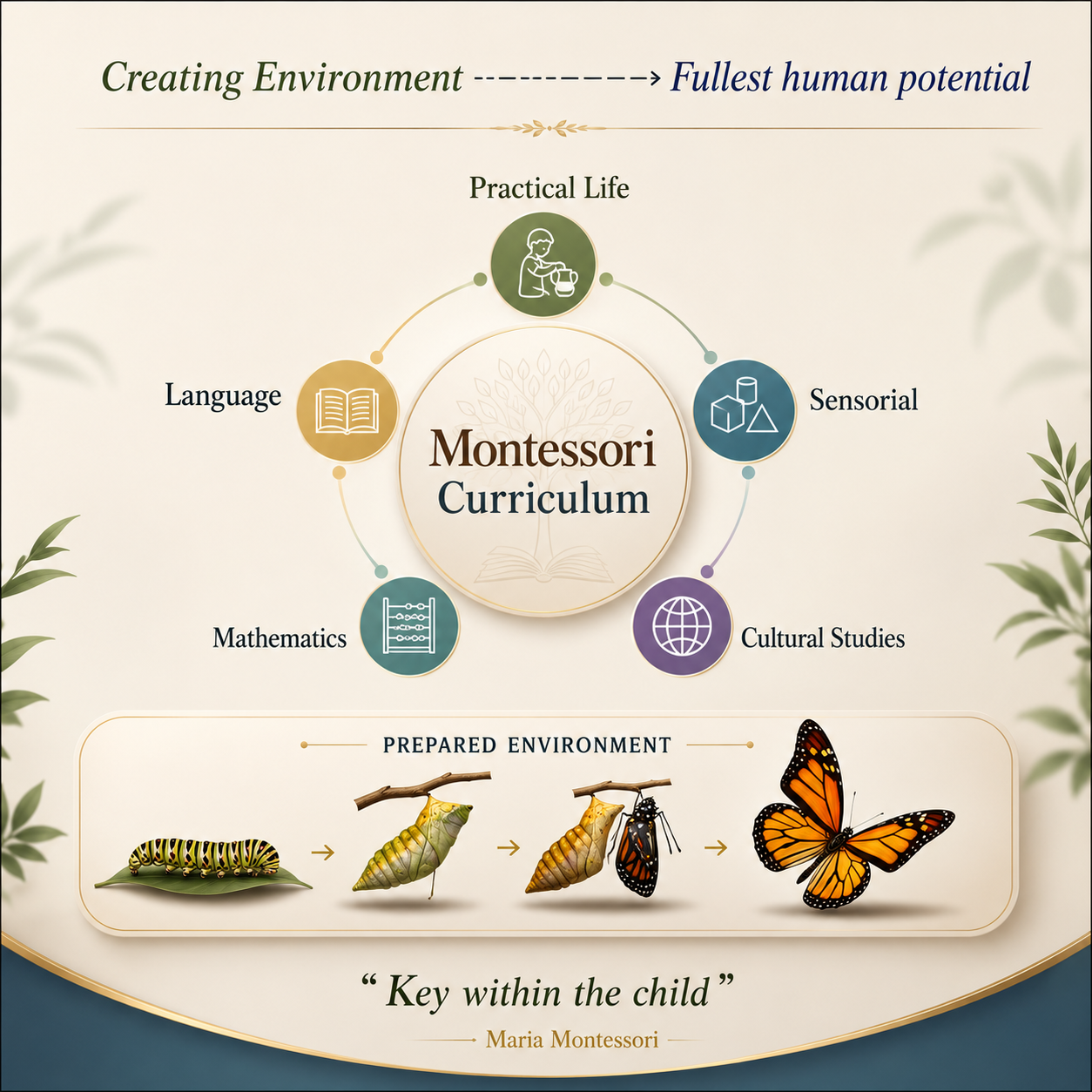
The Montessori Primary curriculum emphasizes a holistic approach to early childhood learning, fostering independence, concentration, creativity, and self-discipline. Practical Life activities form the foundational bedrock, teaching real-life skills that enhance fine motor coordination and personal responsibility.
Sensorial experiences sharpen a child’s perception of the physical world, while Mathematics and Language build abstract cognitive and communication fluency. Cultural Studies introduce geography, botany, zoology, and global diversity—preparing children for a well-rounded future rooted in character and empathy.
Engineered with scientific apparatus isolating single attributes to enable self-correction and intrinsic motivation.
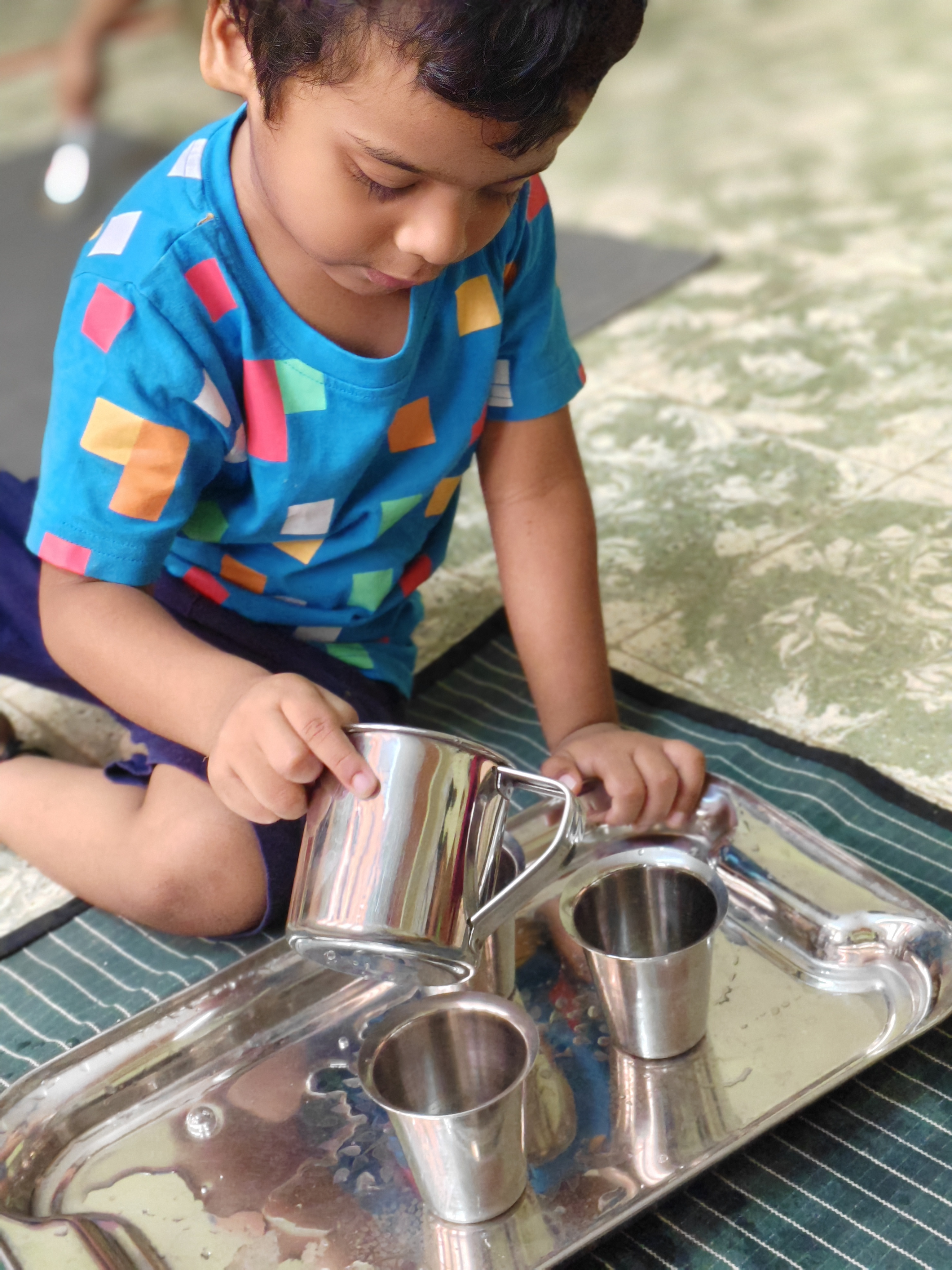
Focuses on real-life tasks like pouring, sweeping, buttoning, and food preparation. Children develop fine motor coordination, concentration, independence, and deep respect for themselves and their environment.

Refines the five senses through specialized apparatus (Pink Tower, Cylinder Blocks, Color Tablets). Children explore color, shape, texture, size, and sound—laying cognitive foundations for math and science.

Introduces mathematical concepts through concrete hands-on materials (Golden Beads, Spindle Boxes, Number Rods). Children progress seamlessly from counting to addition, subtraction, and place value.

Nurtures communication and literacy through Sandpaper Letters, Movable Alphabet, and phonetic awareness. Encourages self-expression, expanding vocabulary, oral storytelling, and early writing confidence.

Broadens world understanding through geography puzzle maps, botany leaf cabinets, zoology cards, art, and music. Fosters global curiosity, ecological respect, and appreciation for cultural diversity.
Dr. Maria Montessori identified temporary developmental windows during which a child’s brain is uniquely receptive to acquiring specific competencies effortlessly and with intense joy.
A passionate desire for consistency, routine, and organized physical surroundings, building emotional security and spatial reasoning.
Effortless absorption of mother tongue vocabulary, phonetics, grammar, and bilingual fluency without formal instruction.
Heightened awareness isolating colors, sounds, dimensions, textures, and pitch through hands-on apparatus.
Refining fine motor control, three-finger pincer grip, equilibrium, balance, and purposeful physical work.
Intense fascination with miniature details in nature—insects, seeds, pebbles—developing acute visual focus.
Inner compulsion to observe social customs, polite interaction, peer cooperation, and respectful community living.
Our primary environment is guided by experienced AMI & Montessori certified practitioners trained to carefully observe individual sensitive periods without intrusive intervention.
The Primary classroom is a living micro-community where children choose meaningful work, care for their environment, and build intrinsic self-confidence.
Harmonizing timeless regional customs, language, and indigenous flora into everyday prepared learning activities.
Children use counters shaped like mangoes, bananas, and jackfruits—making math relatable to local produce.
Puzzles feature Tamil Nadu flora like neem, jasmine, and hibiscus, teaching plant anatomy through native species.
Animal sets include Indian elephants, peacocks, and kingfishers, alongside Tamil nomenclature cards for kolam and temple art.
Children learn to greet elders with "Vanakkam" and address peers respectfully as "Anna" (brother) and "Akka" (sister).
Lessons introduce the cultural significance of Pongal and Tamil New Year, emphasizing gratitude for harvest, soil, and sun.
Children practice sharing meals, serving food with care, and expressing reverence for nature, water resources, and elders.
Explore our prepared environments in Thanjavur, meet certified AMI educators, and experience how native cultural wisdom harmonizes with global Montessori learning.
