

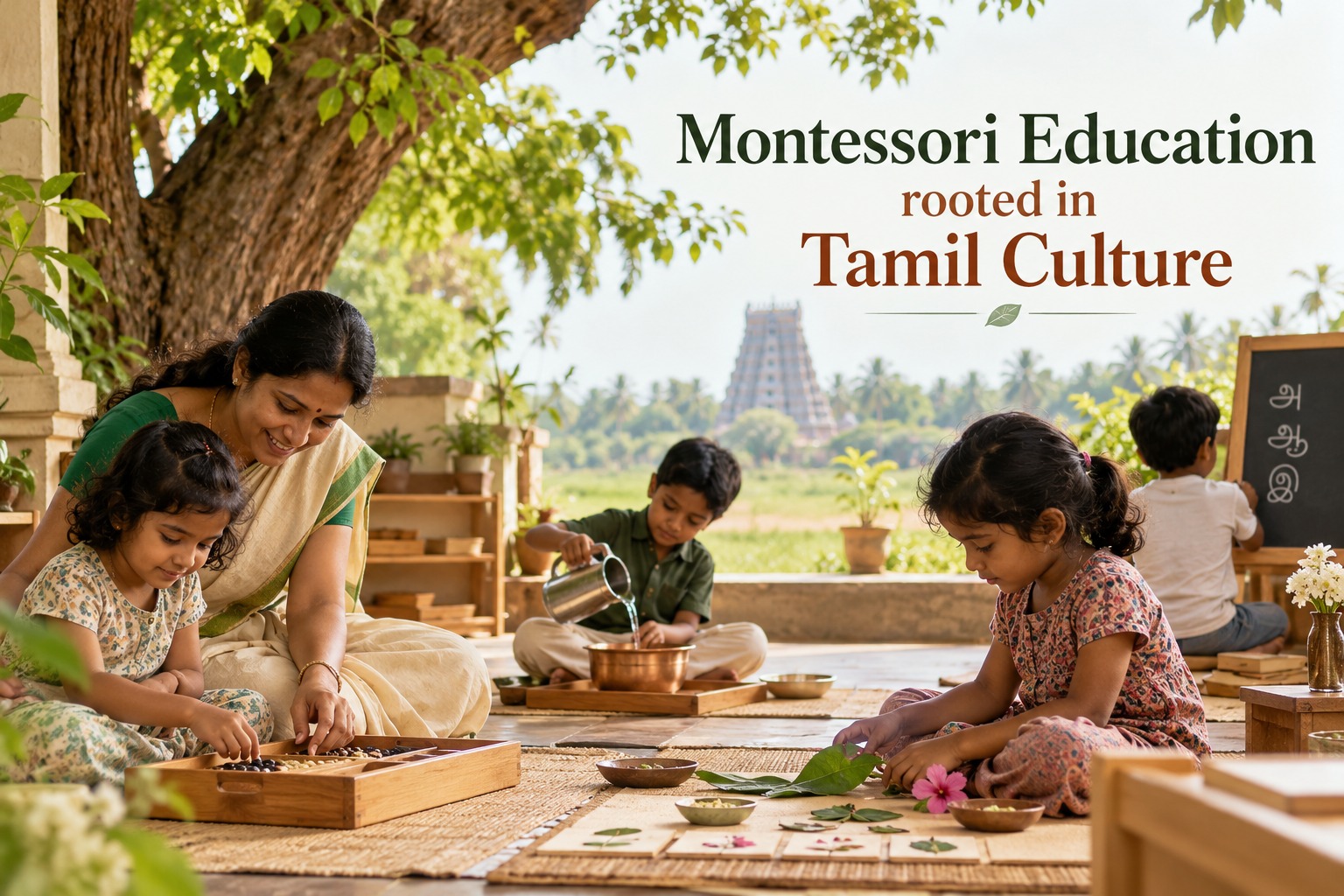
Montessori Education Rooted in Tamil Culture
The Aaranya International School of Montessori Approach
Montessori education begins with a simple principle: respect the child and support the child's natural development.
At Aaranya International School of Montessori (AISM), we believe that Montessori education can be universal in its principles while remaining deeply connected to a child's language, culture, family and local environment.
Our approach brings together Montessori philosophy with the richness of Tamil language, Tamil heritage and the natural environment of Tamil Nadu.
Learning Begins with the Familiar
Children understand the world best when learning begins with experiences they recognise from their everyday lives.
A child growing up in the Thanjavur region can explore:
The Kaveri River and its importance
Paddy fields and traditional farming
Coconut, banana and neem trees
Local flowers, birds and insects
Traditional food and household activities
Village life and local occupations
These familiar experiences can become meaningful learning opportunities. Through observation, hands-on activities and exploration, children begin to understand the world around them.
Tamil as Part of the Learning Environment
Language is not simply a subject. It is an important part of a child's identity and everyday experience.
At Aaranya International School of Montessori, we encourage children to listen, speak, observe, describe and communicate naturally.
Tamil vocabulary, stories, songs, conversations and local experiences can be integrated into the child's learning environment. These experiences help children develop a meaningful connection with their mother tongue and cultural surroundings while building confidence in other languages.
When children can relate learning to their own lives, new ideas become more familiar, engaging and meaningful.
Learning Through Tamil Heritage
Tamil culture provides a rich source of ideas for children's learning and exploration.
Age-appropriate experiences can introduce children to:
Thirukkural and its values
Sangam literature and its connection with nature
Tamil stories and folk traditions
Traditional arts and crafts
Local festivals and customs
Tamil landscapes, plants and wildlife
For young children, cultural learning does not need to involve memorising difficult literature. Instead, children can explore simple values through stories, conversations, practical activities and real-life situations.
Some meaningful values include:
அன்பு – Love: Caring for others and showing kindness.
அறம் – Virtue: Understanding the importance of doing what is right.
ஒழுக்கம் – Good Conduct: Developing respect, responsibility and self-discipline.
முயற்சி – Effort: Learning to try, practise and persevere.
பகிர்வு – Sharing: Understanding cooperation and consideration for others.
These values can become part of a child's everyday experiences at school and at home.
Montessori Practical Life Through Tamil Culture
Montessori Practical Life activities connect learning with everyday tasks. They help children develop independence, coordination, concentration, order and responsibility.
Many of these activities are naturally connected to Tamil family and community life.
Children can practise:
Pouring water independently.
Folding a துணி (cloth).
Arranging plates and cups.
Washing vegetables.
Helping prepare simple food under appropriate supervision.
Watering plants and caring for flowers.
Cleaning their own workspace.
Arranging flowers in a vase.
Caring for a school garden.
These activities are more than simple household tasks. They offer opportunities for children to practise purposeful movement, develop confidence and learn to care for their surroundings.
By connecting Practical Life activities with familiar cultural experiences, children can see that learning is part of everyday life.
From Thanjavur to the World
A culturally connected Montessori environment can provide a foundation for exploring the wider world.
At Aaranya International School of Montessori, learning can gradually expand through the following journey:
Home → Local Environment → Tamil Nadu → India → The World
A child can begin by observing the Kaveri River, then explore rivers across India and eventually discover major rivers around the world.
A child can study a local paddy field, then learn about agriculture, food systems and farming practices in different regions.
A child can identify familiar trees and flowers and later compare plant life across continents.
This progression helps children connect new information with what they already understand. The familiar becomes a bridge to discovering unfamiliar places, people and ideas.
Rooted Here, Ready for the World
At Aaranya International School of Montessori, our vision is to support children as they grow into:
Independent learners
Careful observers
Confident communicators
Thoughtful questioners
Responsible members of their community
Montessori provides the educational foundation. Tamil language, culture, nature and heritage provide a meaningful context for learning.
We believe children do not have to leave their cultural roots behind to receive a global education. They can develop a strong connection with Tamil heritage while building curiosity, understanding and confidence to explore the world.
Aaranya International School of Montessori
Rooted in Tamil heritage. Guided by Montessori principles. Growing towards the world.
Through meaningful learning experiences, respect for each child's development and a connection with the local environment, we aim to create opportunities for children to discover their potential and grow with confidence.