

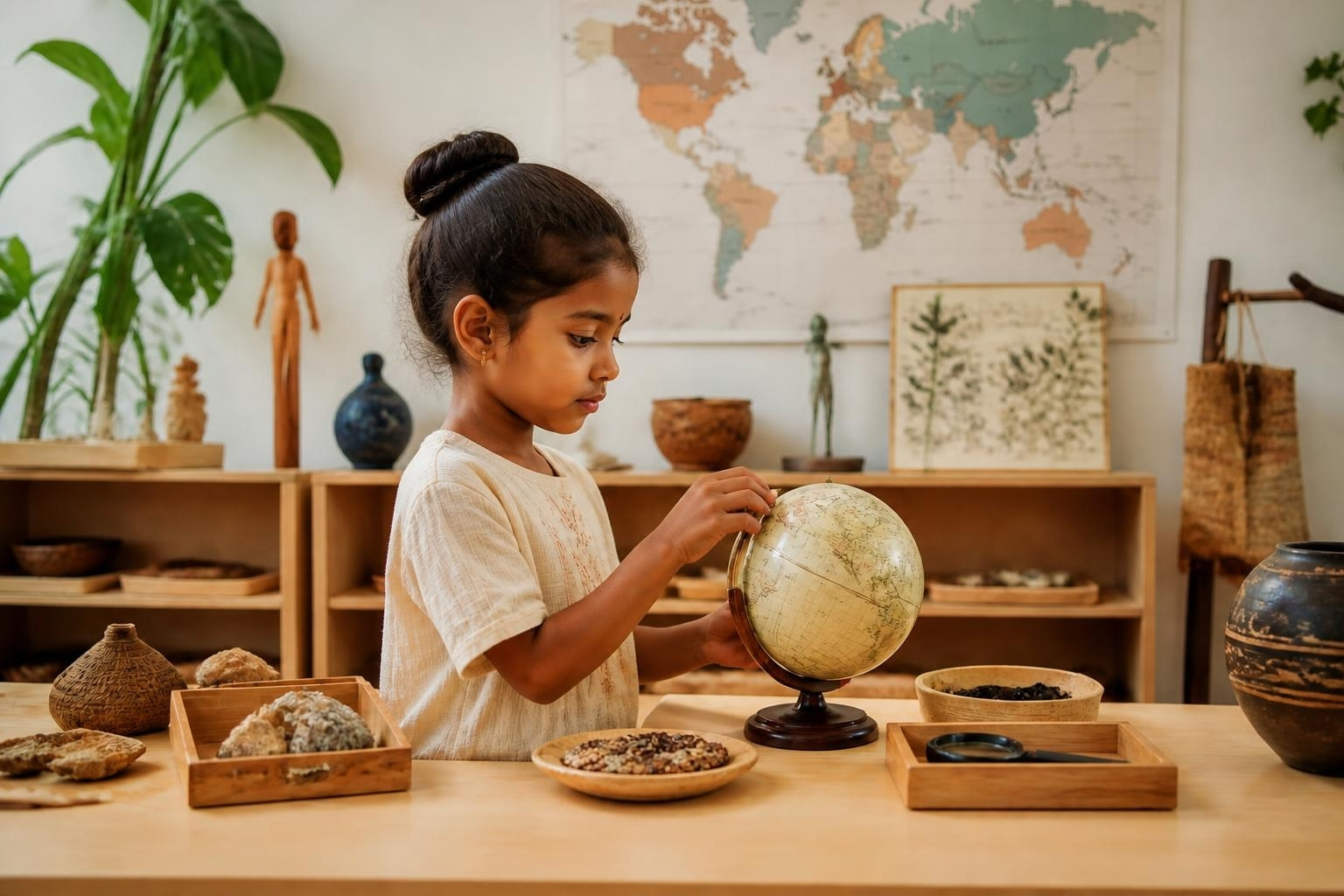
When we speak about Montessori education, we often think about the familiar materials, the prepared environment, independence and self-directed learning. But behind these practices lies a much deeper question: What does it mean to understand the child as a human being? This question brings Montessori education close to anthropology—the study of human beings, their development, cultures, relationships and ways of living.
Beginning With the Human Being
Maria Montessori's work was strongly rooted in observation. Rather than beginning with a fixed idea of how children should behave, she spent time observing what children actually did.
She noticed that children naturally move, explore, repeat activities, communicate, seek order and gradually work towards independence. These are not simply classroom behaviours. They are expressions of the developing human being.
Therefore, Montessori education begins not only with a curriculum, but with an attempt to understand the child.
Development Happens Through the Environment
A human being develops in constant relationship with the environment.
A child touches, carries, observes, listens, imitates, communicates and participates in everyday life. Through these experiences, the child gradually builds knowledge and develops abilities.
This is why the Montessori environment is carefully prepared. The purpose is not to make the classroom attractive. It is to provide meaningful opportunities for movement, concentration, exploration, responsibility and independence.
The environment becomes an active part of education.
The Child Is a Cultural Being
Human development also takes place within culture.
A child grows up surrounded by a particular language, food, family structure, landscape, traditions, occupations, stories and social practices. These experiences become part of the child's understanding of the world.
This gives cultural relevance an important place in Montessori education.
For a child growing in Tamil Nadu, learning can naturally connect with Tamil language, local plants and animals, agriculture, traditional food, crafts, music, festivals and community life.
Culture need not be presented only during a special celebration. It can be experienced through ordinary daily activities. The child's culture can become part of the child's education.
From the Child to Humanity
Montessori education gradually widens the child's field of understanding.
The child begins with the immediate environment and gradually encounters family, community, nature, geography, history and different cultures. At this stage, education becomes an exploration of humanity.
Children can begin to wonder:
- How did people live before modern technology?
- How did humans adapt to different environments?
- Why do people have different languages and customs?
- How have human beings worked together to build communities?
Such questions help children see human history not merely as a collection of dates, but as the story of people responding to their needs and their environment.
Observation Before Intervention
Anthropology and Montessori share another important principle: careful observation.
A Montessori educator does not immediately label a child's behaviour as good or bad.
- A child who repeatedly moves around may be seeking movement.
- A child who keeps repeating an activity may be developing concentration.
- A child who struggles to participate may be communicating an unmet need.
Observation does not mean allowing everything. It means understanding before responding. When the adult understands the child more deeply, intervention can become more purposeful.
Universal Development, Cultural Expression
There is an important balance here.
Children across cultures share many developmental needs. They need movement, communication, meaningful activity, relationships, exploration and opportunities for independence. But the way these needs are expressed can differ from one culture to another.
Therefore, respecting Montessori principles does not mean creating identical environments everywhere. A Montessori environment in Tamil Nadu can look and feel connected to Tamil life while still supporting universal principles of human development.
Montessori as an Understanding of Humanity
Perhaps this is one of the most valuable ways to look at Montessori.
It is not simply a method for teaching children to read, write or calculate. It is an approach that asks us to observe the developing human being and create conditions in which development can unfold.
"What kind of human being is developing through this environment?"
The deeper question is not only: "What should the child learn?" It is also: "What kind of human being is developing through this environment?"
When education begins with that question, the classroom becomes more than a place of instruction. It becomes a place where the child gradually discovers self, community, culture, nature and humanity.
Conclusion
And this is where Montessori and anthropology meet—not simply in the study of the child, but in the effort to understand what it means to become human.